

Templates and governing context
Word or Excel templates, SOPs, policies and project sources
USE CASE · Computer system validation (CSV) · GAMP 5 / CSA
The evidence that your system reliably does what it should: traqx prepares requirements (URS), specifications, tests – and the proof that everything fits together (traceability) – from your SOPs, templates and project sources — every block source-bound, every decision with your experts.
No obligation · personal · straight in the calendar

THE RECURRING PATTERN
The work case uses the same controlled traqx logic as every other document use case.
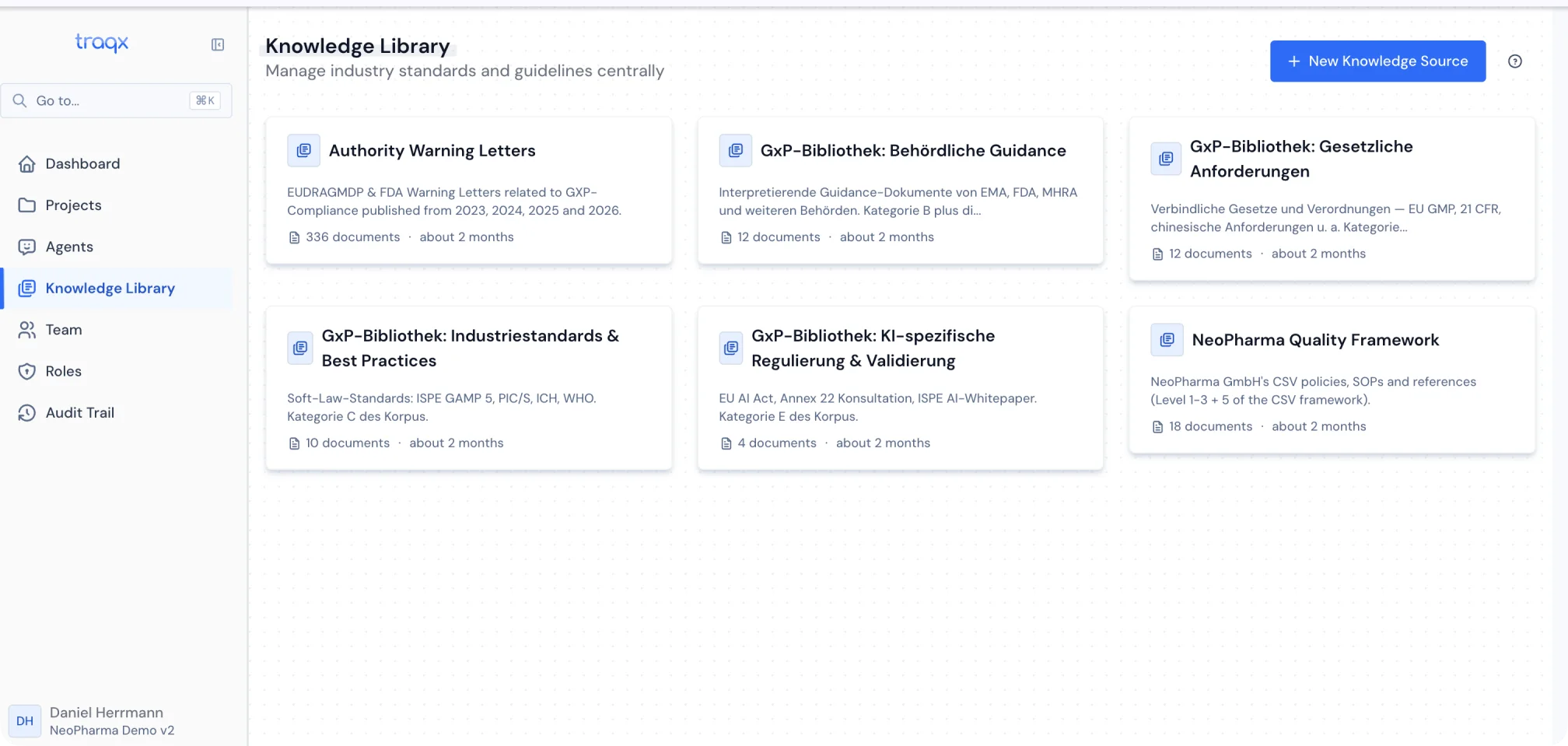
Word or Excel templates, SOPs, policies and project sources
Sources, changes and open points stay connected in the work state.
The expert reviews and decides; formal approval stays in the responsible process.
Why CSV takes so long
The V-model is proven. What slows projects down: the same rationales, requirements and traceability links are searched for, phrased and reviewed again and again. The more systems, templates and sites are involved, the harder it becomes to keep a consistent standard.
Validation projects often hinge on individual experts. When that person leaves, the knowledge leaves — and every follow-up project starts almost from scratch.
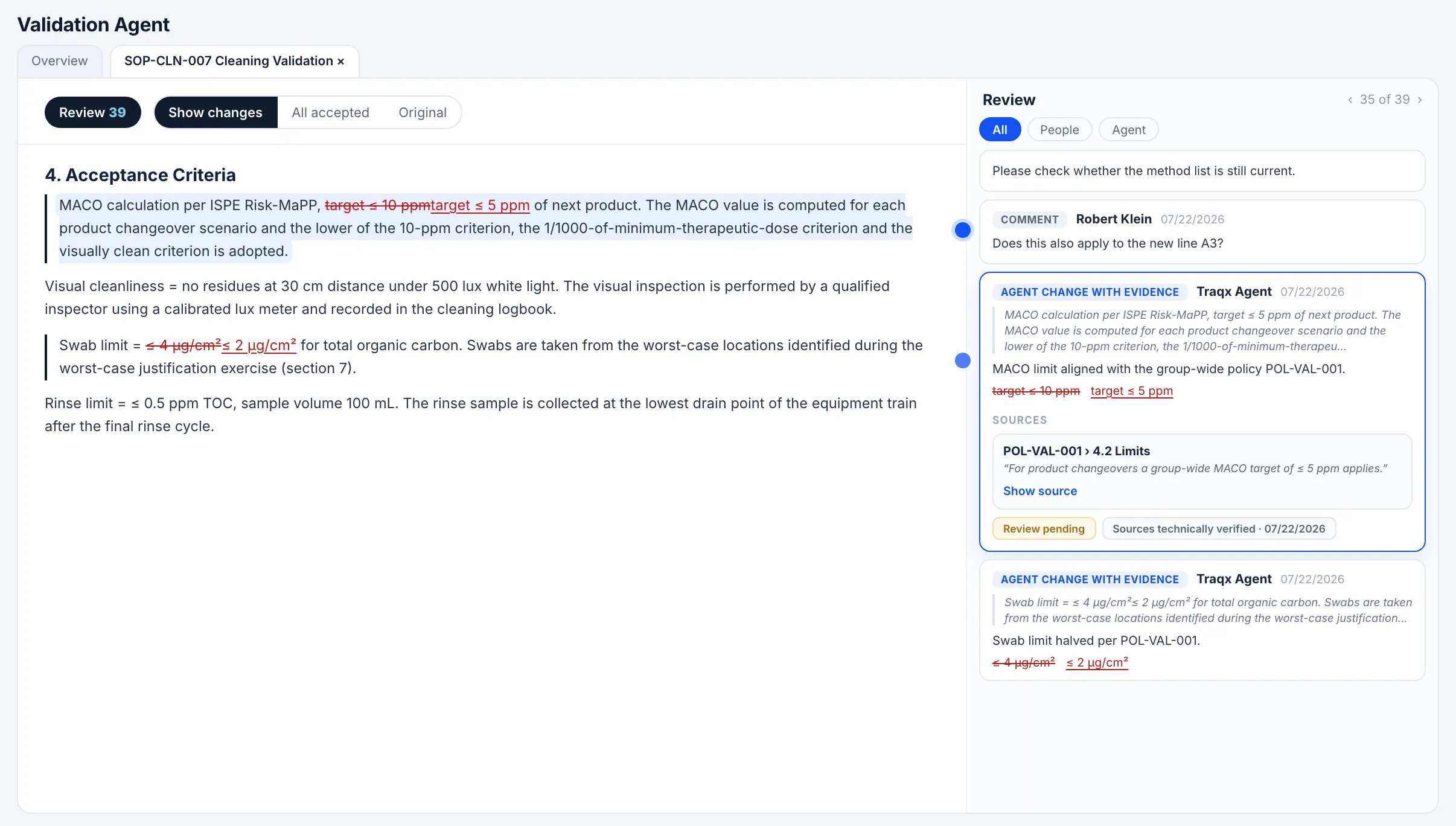
AI values live as pending suggestions on the block they belong to. The stored content stays unchanged until a human acts — no unattended document fills itself.
The same requirement ends up in four documents – requirements (URS), specification (FS), test cases, traceability matrix. Every deviation between them gets flagged at the next audit.
Acceptance, correction or rejection remains with the expert. traqx documents the person, role, time and rationale of the review decision traceably.
Which SOP, which clause of the standard backs this requirement? In review it is looked up line by line by hand — late, laborious and error-prone.
traqx searches only inside the source pool you have approved. Every citation is checked deterministically against that pool; a fabricated source is made visible as a warning, not served as truth.
Built for the AI requirements of EU GMP Annex 22: AI prepares the work, your experts review and decide — traceable in the audit trail.
THE CONNECTED EVIDENCE PATH
Five stations, one connected work state.
By construction
CSV is ready to use today. We only publish real time or cost effects once we have robust real-project or case-study data.
01
Reviewed blockssource-bound02
1 NTraceability03
0changes without your approvalOPERATIONS & SYSTEM FIT
AI-powered Computer System Validation software
In short: the software prepares the validation documents, your experts review and decide. AI-powered Computer System Validation software can prepare URS, specifications, risks, tests and traceability along controlled SOPs, templates and project sources. In traqx, the source, version, status and changes remain visible for review; citations are checked deterministically. The result is a reviewable work package, not an automated validation decision. Quality and the responsible subject-matter roles assess intended use and risk, review the content and evidence, and decide on acceptance and formal approval. EU GMP Annex 11 requires the application to be validated and the IT infrastructure qualified. The FDA CSA guidance describes a risk-based assurance approach for production and QMS software in the medical-device context; it is not a blanket replacement for EU GMP CSV.
FAQ
Computer System Validation is the documented evidence that a computerised system in a GxP environment reproducibly does what it is supposed to do — from requirements (URS) through risk assessment and testing (IQ/OQ/PQ) to attributable approval. The governing frameworks are GAMP 5, EU GMP Annex 11 and 21 CFR Part 11.
Computer Software Assurance (FDA final guidance) shifts the focus from documentation volume to risk-based testing depth: critical functions are tested deeply, uncritical ones leanly. CSV remains the framework — CSA determines how deep you test. The details: CSA vs. CSV.
AI for CSV handles substantive work across several validation artefacts: it evaluates sources, prepares URS, FS, risks and tests as connected drafts, builds traceability and keeps changes visible. Classic validation software often organises documents, tests and approvals. traqx replaces neither the technical review nor formal approval; the expert decides in the existing process.
Only under clear conditions. Intended use, risk and the regulated process determine where AI is appropriate. GAMP 5 Second Edition addresses AI/ML explicitly. The Annex 22 draft excludes Generative AI from critical GMP applications; for non-critical applications, adequately qualified and trained personnel remain responsible for output suitability. traqx provides a controlled draft with visible source and status for that review.
There is no standard duration; risk class and system scope set the pace. In practice it is rarely the testing itself that costs time, but manually holding together documents, reviews and traceability. With clearly phased steps and source-bound drafts the process becomes predictable — without losing testing depth. A phased plan: this guide.
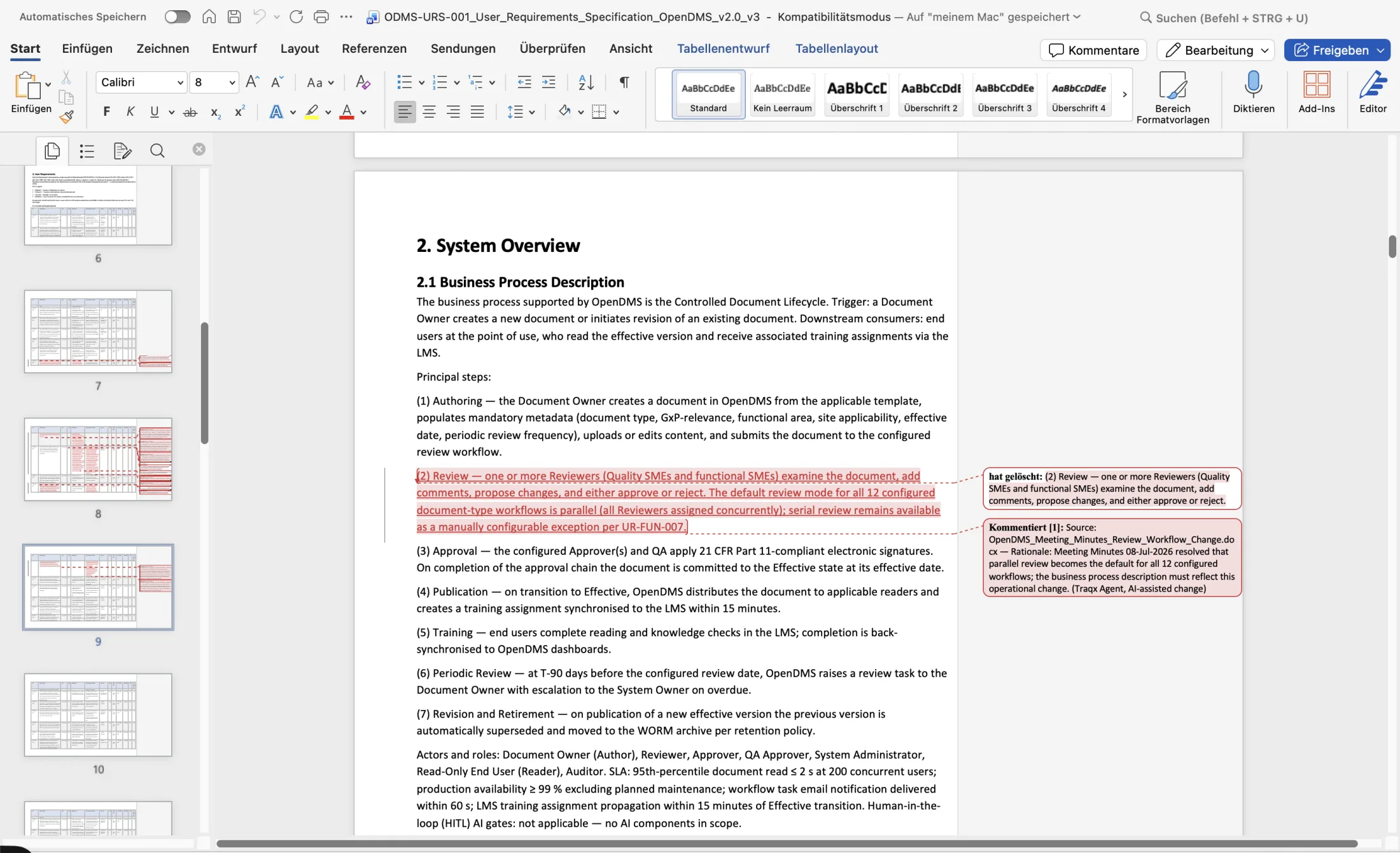
Yes. The agent checks the new decision against the project sources and connected documents, then identifies the affected sections. In the revised Word file, the new wording appears as a tracked edit. A comment names the source and explains the proposal. The result can be reviewed like any other technical revision in Word.
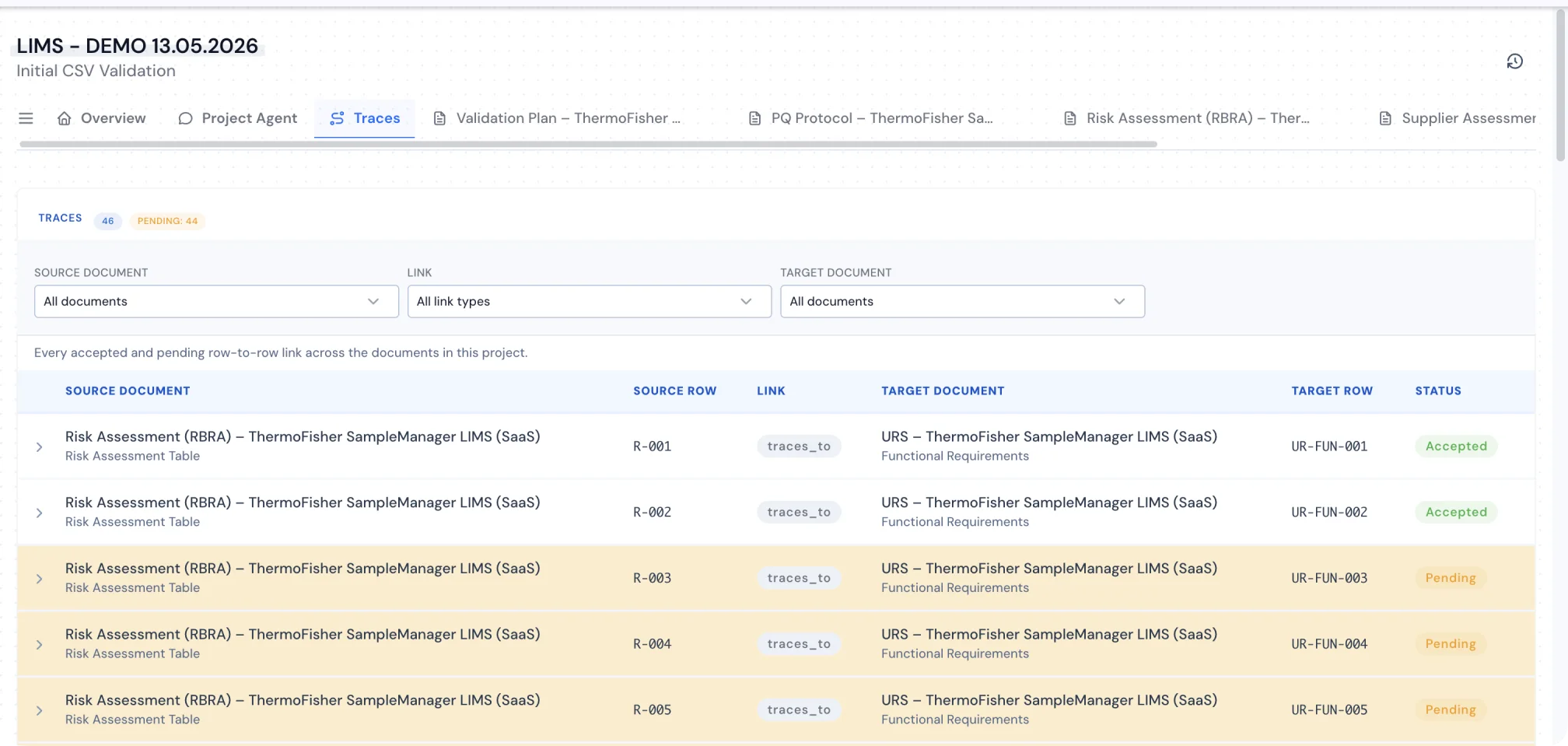
traqx connects requirements, risks and tests row by row as traces. Accepted and Pending remain clearly separate. Citations are checked against the sources used; an expert confirms or rejects the technical relationship.
ONE PRODUCT · ONE REAL DOCUMENT
In the personal live demo we clarify your template, governing SOP or policy and concrete task — and show the document workflow directly in the system.
No obligation · personal · straight in the calendar