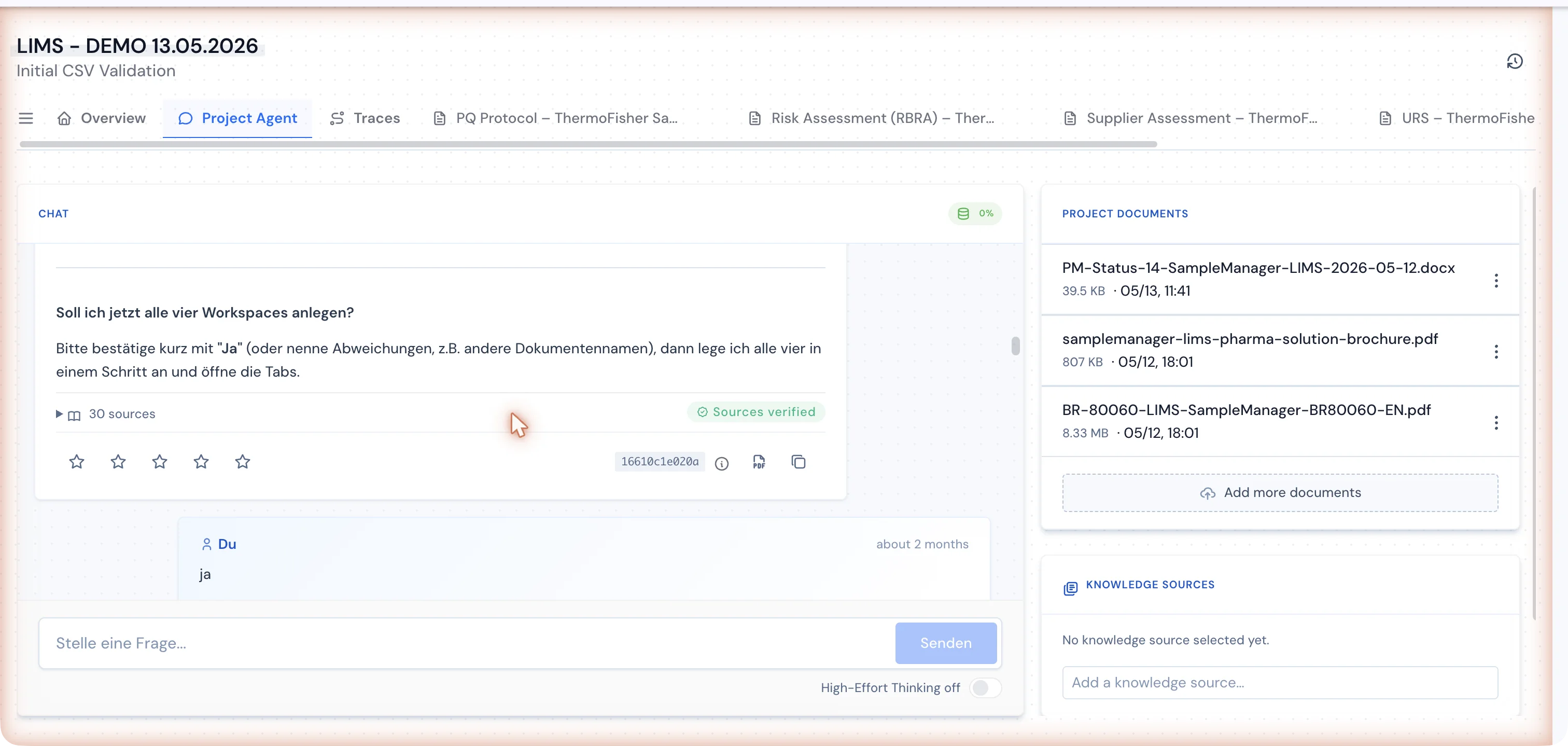
01 · Controlled sources
Relevant knowledge stays controlled and connected.
Policies, SOPs, statutory requirements, guidance, best practices, manuals and project files form the defined source space — not the open web.
The expert reviews and decides.Trust · provable for QA, IT and business
traqx shows which source, which version and which review status sits behind an AI-assisted decision — before it enters the process.

What QA, IT and business need to see
The human defines the task and standard. traqx connects knowledge, documents and agents. The Trust Architecture keeps the basis, change and decision reviewable.
The proposal is prepared from the applicable SOP, the current system context and the selected template.
Affected requirements and documents are listed with their source and review state.
VISIBLE IN THE PRODUCT
It is a visible state in the work itself: sources, links, changes and human decisions stay reviewable where the document is created.
01 · Controlled sources
Policies, SOPs, statutory requirements, guidance, best practices, manuals and project files form the defined source space — not the open web.
The expert reviews and decides.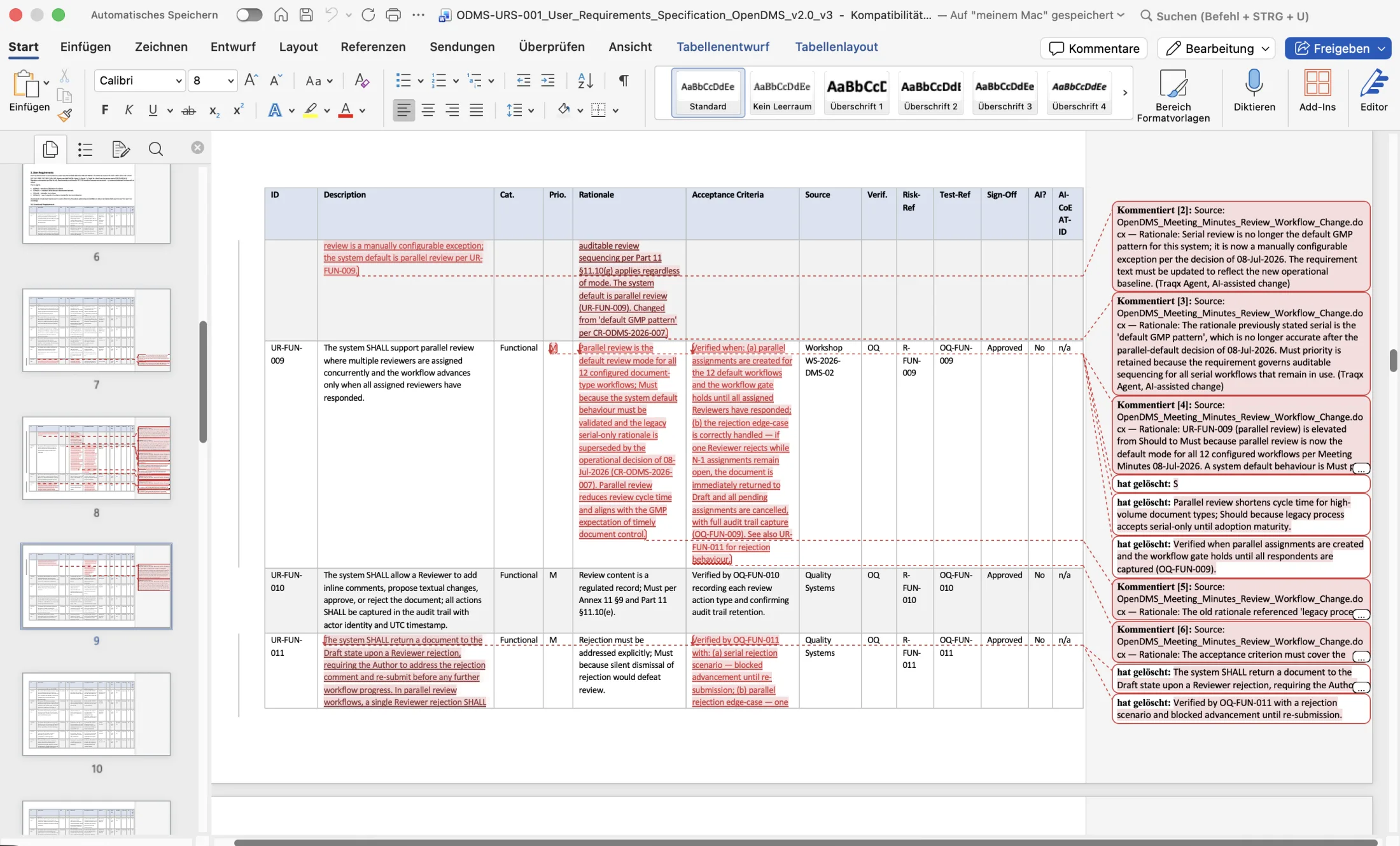
02 · Source evidence
Citations lead to file and section. traqx checks every source reference deterministically; a score does not replace that verification.
The expert reviews and decides.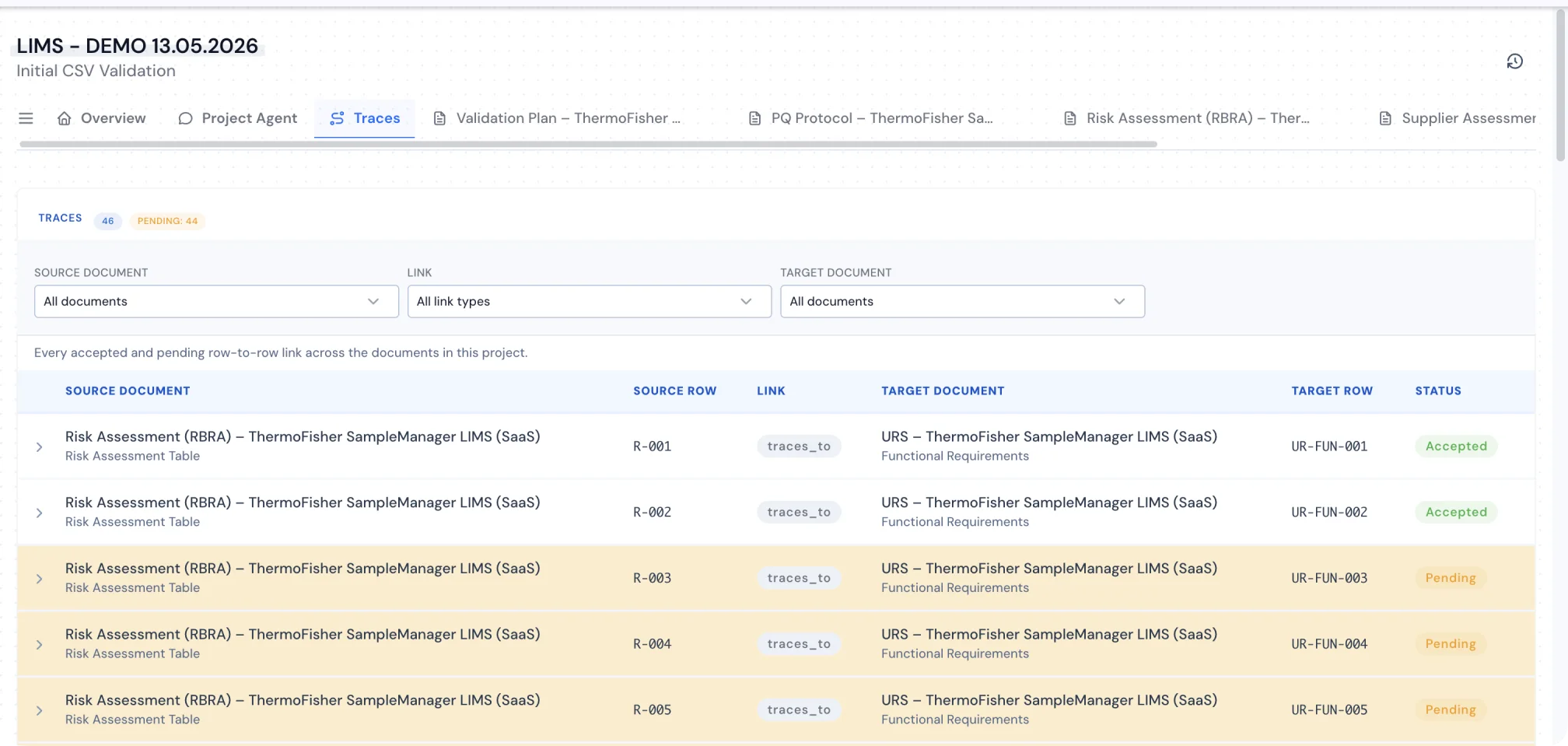
03 · Trace states
Traces connect work objects row by row. Accepted and open links remain separate states, including after changes.
The expert reviews and decides.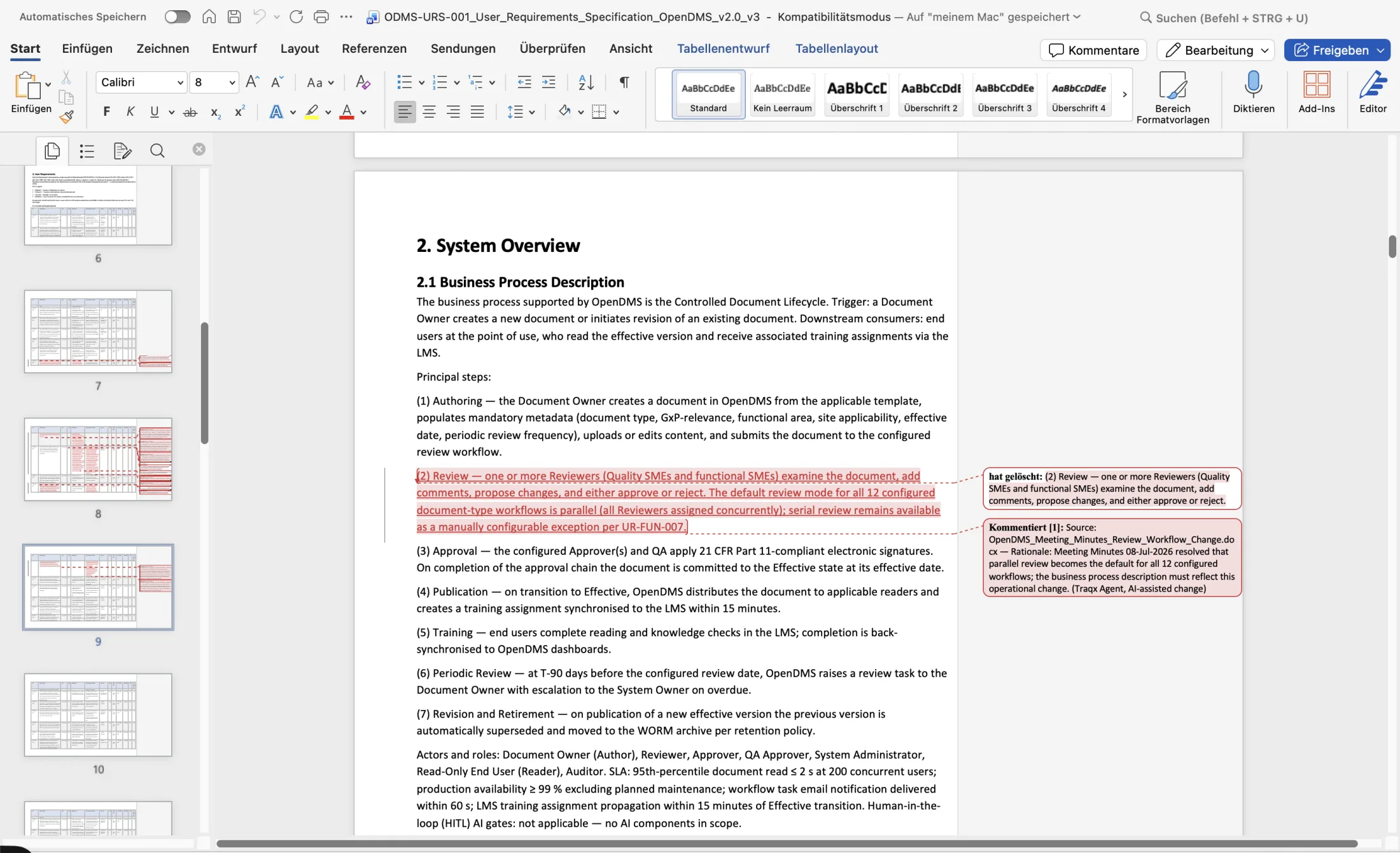
04 · Human review
The Word view keeps tracked changes and source comments next to the affected content. The expert reviews, corrects and decides.
The expert reviews and decides.Assurance Ledger
traqx does not turn trust into documentation after the fact. Evidence is created while the work happens: source, version, role, review, decision and boundary stay visible on the work object.
Regulatory references are an assessment frame for the concrete use case. They do not replace a customer-specific validation decision.
Read next: EU GMP Annex 11 vs Annex 22 · EU GMP Annex 22 for AI · ALCOA+ in GxP
Every AI output stays marked as a suggestion until expert review.
traqx verifies source references deterministically — independently of human review.
Customer documents stay within the agreed tenant and hosting scope.
sees not just text, but source verification, review obligation, rationale and decision.
sees data flow, model boundary, hosting setup and deletion logic.
sees speed that is not lost later through rework.
Formal certifications and a dedicated trust center are in development; the status will follow once it is reliable.
Current status on business continuity, disaster recovery and incident handling: available on request as part of vendor qualification.
EU-hosted. No model training on customer data. Validation responsibility and intended use remain customer- and scope-specific.
Quality sign-off · operational review frame
Before productive use, Quality needs more than a convincing output: a scope-specific evidence package for the system, data, testing and human decision. This frame connects EU GMP Annex 11, the EMA AI reflection paper and the risk-based GAMP lifecycle. The rows are practical go/no-go questions, not a verbatim universal mandatory checklist. Roles and release paths follow the customer-specific PQS and its responsibility matrix.
Sources checked: 18 July 2026 · Evidence depth remains intended-use- and risk-based.Process Owner + QA · approved before use
Data Owner + QA · permitted space documented
IT / System Owner · release state identified
Validation Owner + SME · criteria set in advance
Process Owner + QA · role and review depth named
System Owner · evidence path checked
System / Model Owner + QA · triggers and escalation defined
Procurement + IT + QA · responsibilities and evidence assessed
INSPECT THE CONTROL LOGIC
The first appointment is a 15-minute introductory call. If a product walkthrough is the right next step, we arrange the system and strategy call separately.
Book a meeting & start free → Continue with: traqxUse casesFAQ