
traqx

Change Control · GAMP 5 / Annex 11 In development

See the change impact before it goes through.

Systems, SOPs, tests and documents are linked to the change before the validated state goes blurry.

Relevant to GAMP 5, EU-GMP Annex 11 and 21 CFR Part 11.

  • Assess impact first, then approve.
  • Deltas instead of scattered lists.
  • Approval with rationale and evidence.

The full platform

GAMP 5EU-GMP Annex 1121 CFR Part 11ALCOA+

Change control lifecycleAnnex 15 §11 · ICH Q9(R1)

CHANGE CONTROL · VALIDATED STATE ANNEX 15 §11 · ICH Q9(R1) PLANNED Request Scope §11.2captured · lockedtrigger linkedowner pendingdraft · planned Product quality · PQSDocumentation · ValidationRegulatory · dossierCalibration · Maintenance §11.4 · 7 areas · open no implementation before approval · effectiveness §11.7 Impact ClassificationUncertaintyImportanceComplexity Supporting datareviewed · §11.6 Approval QA · CSV · Ownerhuman decides Implementation Verification AUDIT-TRAIL who · what · when · basis · source linked

Change captured and locked · planned, in preparation

Why Change Control risks the validated state

A change is quickly requested. Its effect is not.

A change rarely touches only one thing. It runs through systems, SOPs, test cases, specifications and their evidence. If the impact only becomes visible after implementation, the validated state is already blurry — and the proof that it is not is missing.

01

The impact is underestimated

Which systems, documents and tests does this change really touch? If the impact assessment is filled from memory, an affected artefact too often stays undiscovered — until it shows up in the audit.

02

References fall apart across spreadsheets and emails

What connects to what lives in people's heads, spreadsheets and email threads. Every link between change, artefact and evidence is searched by hand — late, laborious and error-prone.

03

The evidence arises afterwards

That the assessment was complete, the approvals were in place and the deltas were implemented is pieced together after the fact. Exactly this gap between decision and evidence is a finding in the making.

How traqx should map your Change Control

Assess impact first — then let it go through.

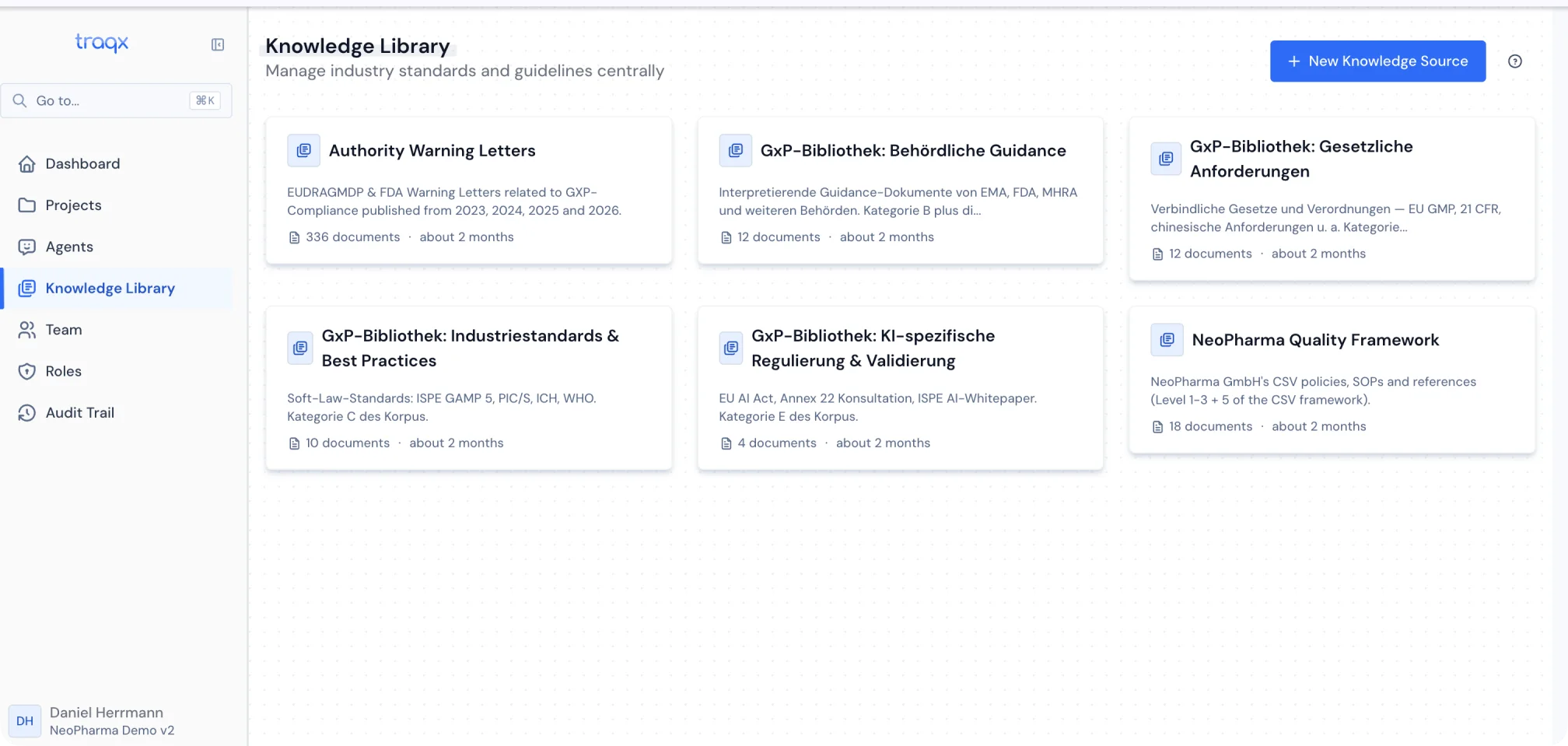
The planned workflow builds on your change SOPs, templates and source spaces: Policy → SOP → Template. traqx should pre-structure assessments, make references visible and keep decisions traceable — you assess and approve. Generate · Verify · Monitor. The steps below describe the planned discipline, not a live feature.

Step 01 Capture change The change request is captured in a structured way — trigger, scope and affected area in one place. Planned: traqx proposes fields as a proposal, you confirm; with the sign-off the request is locked and immutable. Capture & lock — principle evidenced, change shape in preparation
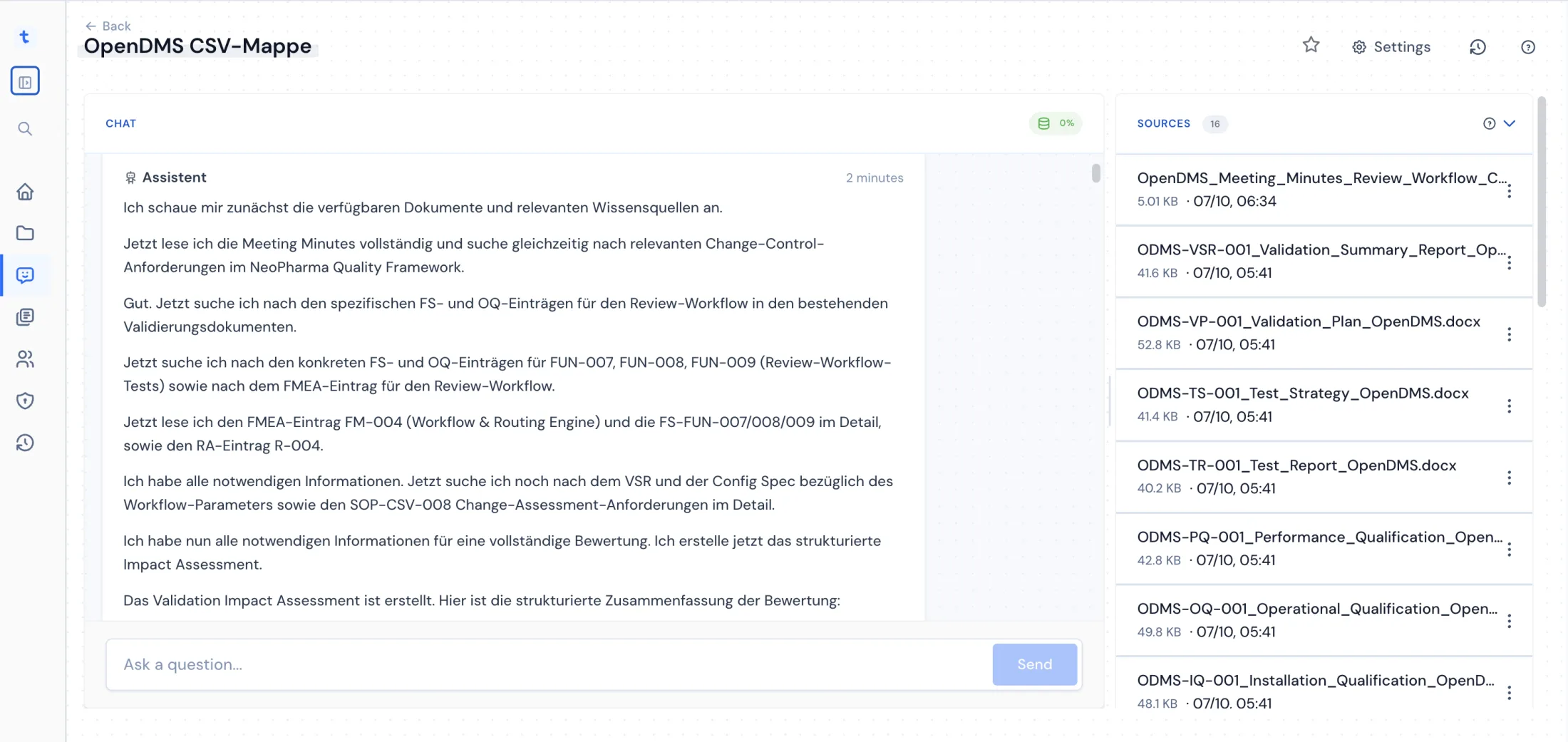
Step 02 Prepare impact assessment traqx should pre-structure the impact assessment: which systems, SOPs, tests and documents the change touches — proposed source-bound, not guessed. You review, add and close the assessment. Source-bound proposal — in preparation
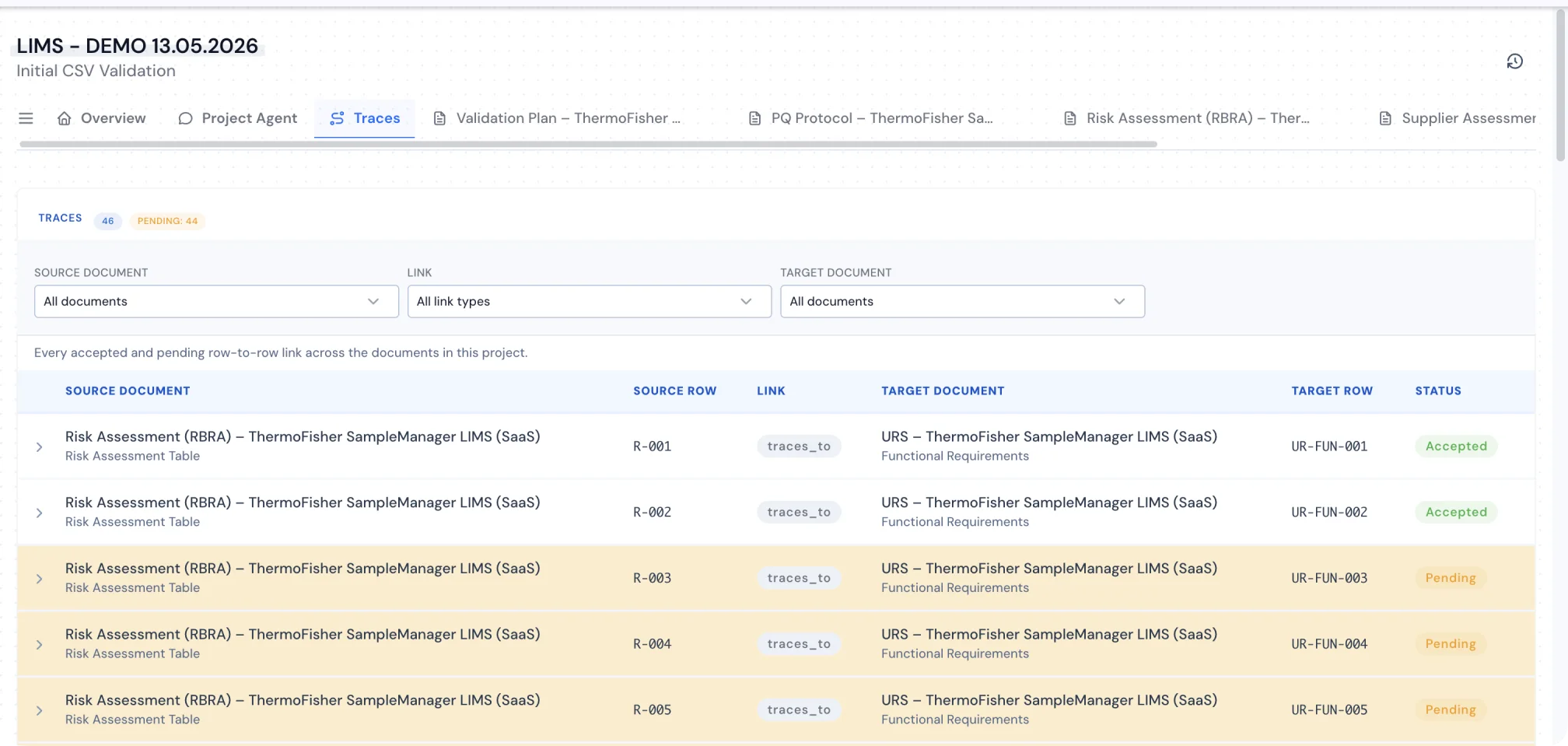
Step 03 Link affected artefacts Change, systems, documents, SOPs and tests are linked to one another, instead of living in separate lists. Planned: the references are clickable and traceable — from the change to the affected artefact and back to the evidence. Linked references (traceability) — in preparation
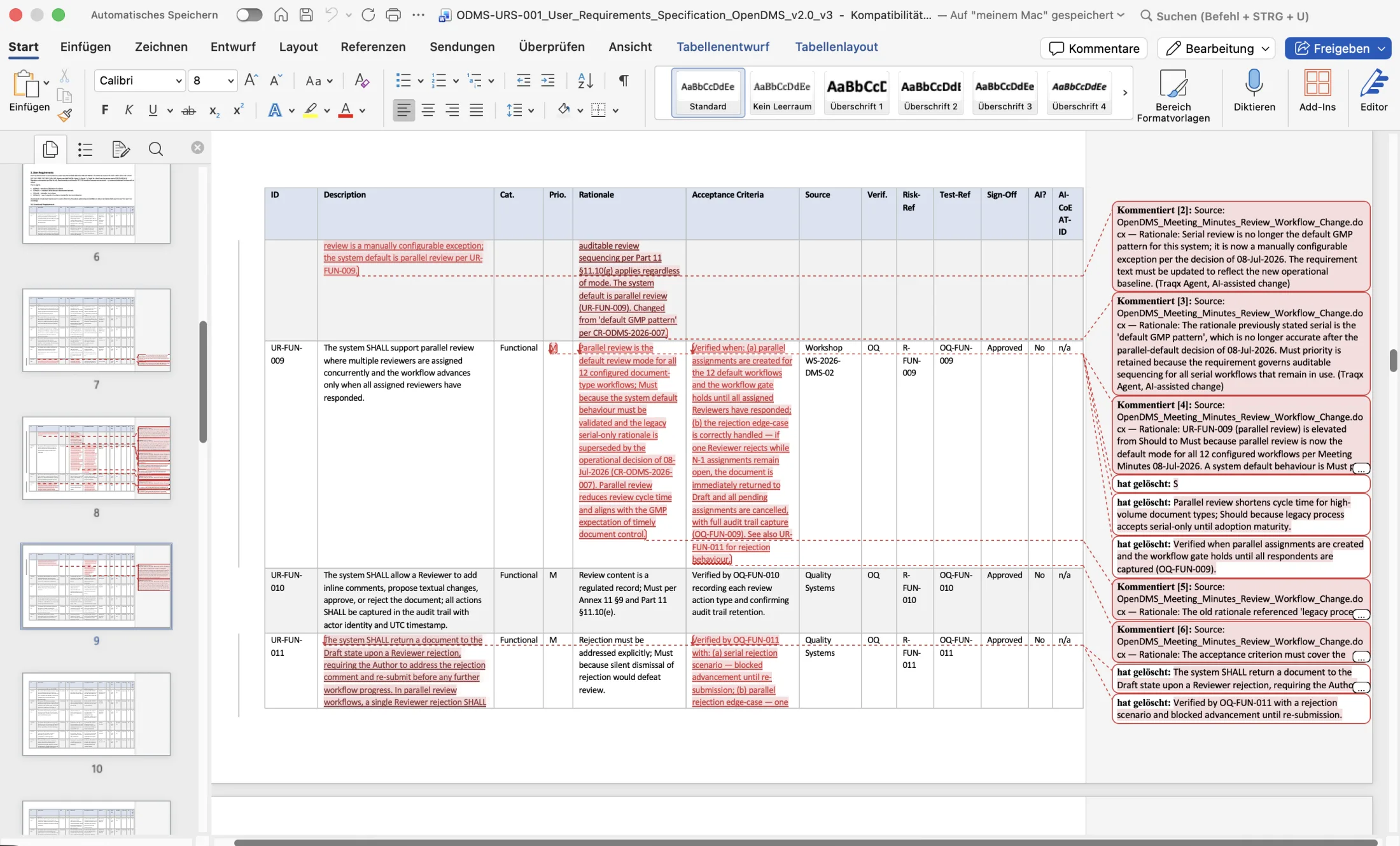
Step 04 Derive test and document deltas From the assessed impact, the concrete deltas should arise: which tests run anew, which documents need to be adjusted. For tabular blocks a row- and cell-level diff is planned — what is added, dropped, changed. Row-level diff of the deltas — in preparation
Step 05 Manage approvals Every assessment and every approval is an attributed, audited decision — signed with your name. Planned: a rejection requiring a rationale demands a typed reason that is recorded with the decision. Attributed approval (21 CFR Part 11) — in preparation
throughout Hold evidence — audit trail Across all steps the audit trail should write along: which change, which effect, which approval, on what basis. The change history is append-only at the database level — it can be neither altered nor deleted. Change history append-only (DB trigger) — principle evidenced

Why this should hold up in the audit

The AI pre-assesses. You stay accountable.

When planned too, the traqx core principle applies: AI output is never silently written into a validated record. Until your approval, every impact assessment stays a proposal — and only your confirmation makes a change effective.

Generate A proposal stays a proposal Proposed impacts and deltas live as pending proposals on the affected artefact. The approved state stays unchanged until a human acts — no change goes through unsupervised.
Verify Approval with mandatory rationale Every acceptance or rejection is an attributed, audited decision. A rejection marked as requiring a rationale demands a typed reason — which is recorded with the decision.
Monitor Source-bound instead of invented The retrieval reach is limited to your approved source pool. Every citation is checked deterministically; an invented source is surfaced as unverified, not output as truth.

By construction

What a Change Control workflow should structurally secure.

Impact

before implementation

Effects on systems, SOPs, tests and documents become visible before the change goes through operationally — not afterwards in the audit. This keeps the validated state sharp instead of blurry.

1 N

link

One change, linked through to every affected artefact and its evidence — the references arise along the way, instead of being pieced together afterwards from spreadsheets and emails. Gaps become visible earlier.

0

silent AI writes

No assessment and no delta lands in the record without human approval. By construction — not by discipline. This way you go into QA review and inspection better prepared.

Change Control is in preparation — not yet available; the value and workflow above are planned, not a live feature. The structural properties describe the intended construction — no guarantee of an audit outcome, but better preparation. We publish real time or cost effects only with reliable pilot or case-study data.

Questions from practice

Common questions on change control

What is change control in GxP?

The controlled process of assessing, approving, implementing and evidencing changes to systems, processes, equipment or documents. The goal: no change alters the validated or qualified state unnoticed.

Which changes require change control?

All changes with potential GxP impact: to validated systems, qualified equipment, critical processes, controlled documents or suppliers. Classification is risk-based — what counts is an evidenced impact assessment, not the size of the change.

What belongs in a change request?

Description and justification of the change, impact and risk assessment, affected systems and documents, planned actions including requalification or revalidation, approvals and the final effectiveness check.

How does AI help with impact assessment?

It finds affected documents, systems and dependencies across the whole inventory and drafts the assessment with source binding — precisely the cross-connections that manual reviews miss most often. Your team decides and approves.

More disciplines

One platform, many use cases.

Same trust architecture — sources first, AI as a suggestion, human decides, audit trail stays — across every GxP discipline.

Security & standards · built for traceable evidence

Made in Germany GDPR-compliant · EU-hosted No model training on your data
Built forGAMP 5EU-GMP Annex 1121 CFR Part 11ALCOA+
MembershipsISPEPDAGQMA

Founded by CSV experts with 15+ years of domain expertise

Live demo · Change Control in preparation · join now

Help shape this use case with us.

Change Control is in preparation — and early partners help determine the maturity level. Bring in a real change process that protects your validated state; we build the workflow on your reality, instead of claiming a finished product. We define scope and goals together before the start.

No sales pitch — a short conversation around your concrete Change Control scope. Change Control stays clearly marked as a roadmap use case; the documented assessment is yours even if you say no afterwards. EU-hosted, no model training, source room deleted on request with evidence.

Joint build-out only with a few partners · conversations in order of arrival